Orange Tree Orchard
HomeGoldilocks and the Three Metals
Why Gold Standards Don’t Work - N R Scott
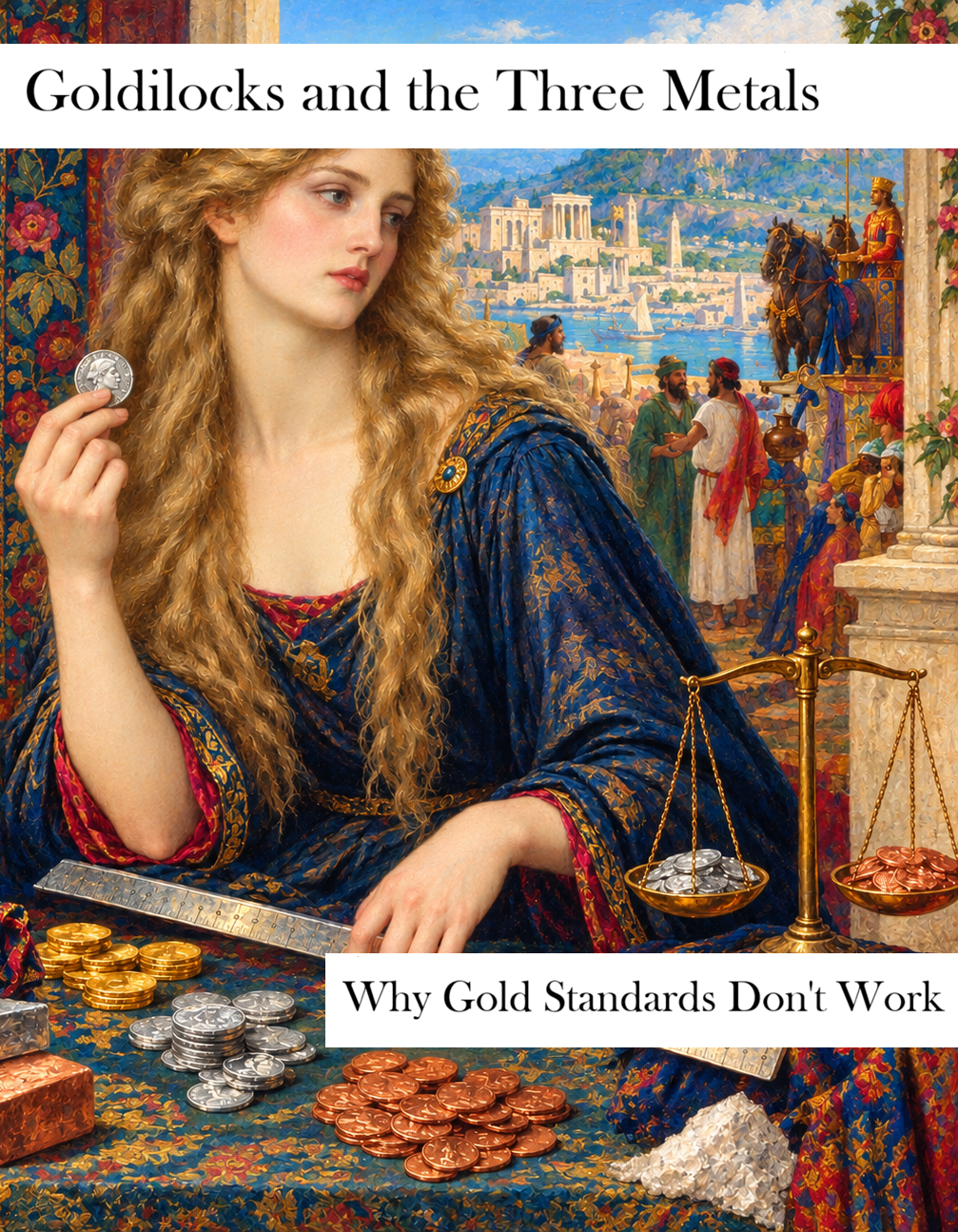
To download a free PDF copy of this booklet click:here
Articles:
Gold Standards Don’t Work
Gold Standards Don’t Work: Part II - Goldilocks Knows
Anything Can Be Currency In A World Without Tax
I’m Off The Gold Standard
Why Gold (and Silver) Standards Don’t Work: Part III - Human Meddling
Why Gold Standards Don’t Work (refresher)
Money Extras:
Metals, Markets and Digital Jewellery
Bitcoin: Currencies Are Backed By Cultures
A Money Tree on a Desert Island
Gold Standards Don't Work
The other week I had the flu - well, a cold - but it was enough for me to sit around for a few days doing nothing. As it happens it was something of a blessing, as in my lazy, snotty boredom I ended up watching videos about the history of money. This clarified in my mind why gold isn't a good currency, and why gold standards aren't a good idea.
A currency is something that helps lubricate the economy. An oil that helps people trade their time and goods.
So a good currency isn't just something that gives people confidence that it's a good store of value. It also has to be readily available enough that everyone has access to it. The peasant paying his landlord, the old woman buying her loaf of bread, the businessman making his trades.
It's something that balances these two things. Rare enough to be worth something, but common enough to be readily utilised.
This is why gold isn't good as a currency. It's too rare. Too precious.
It's a great store of value, but not a great currency.
It's similar with Bitcoin. That too, like gold, is more a store of value than a currency. It is scarce, therefore people value it. Therefore people are reluctant to let go of it.
An Example
For instance, let's say you're someone who owns gold and/or Bitcoin, and you want to buy something that costs £10. You'll be more than happy enough to spend £10 in pounds sterling to buy it, however if someone suggests you use your gold or Bitcoin, you'll balk at the idea. As you believe over time your gold will increase in value relative to other things, and you believe your Bitcoin is "Going to the Moon."
So as gold is a very, very good store of value, you're very, very reluctant to let go of it. You'd much rather use something less precious for daily transactions.
Gold, Silver and Copper
Historically it was generally silver that was used as a standard, not gold. This makes sense as silver is less precious, and it's a natural intermediary between gold and copper. People would generally use copper and silver coins for normal trade.
Supposedly, gold only really began being used as a de facto standard around 300 years ago by Britain. It probably worked quite well for Britain because Britain was the ascendant power, and the rest of the world still used silver - so it was a luxury position. However, when everyone else jumped on the gold standard in the 19th century that appears to be when things started going a bit haywire, and when gold decoupled from silver. This makes sense, as pegging an entire economy to one commodity - especially the most precious and rare commodity - is asking for trouble. People are always going to want to hold on to gold, and especially so when things start looking dicey. How can you lubricate everyday trade with something no-one wants to let go of?
Again, even in the days of silver standards, things were much more organic, and people used multiple other things as currency too. They had a degree of freedom to trade and barter without every transaction being watched and taxed by government - and the tax needing to be paid in the specific state issued currency.
The modern world with its monolithic governments, taxes and standards is really the straitjacket that's locked everything into one universal money measure - whatever form it takes.
Fiat-philia
Personally, I actually like fiat currency. This won't be popular, but as an actual currency - an oil for trade - it's much better than something pegged to a specific commodity. Of course, they're open to abuse by governments and banks that are in a position to inflate them, but this also makes them flexible enough to function. If you want a store of value get some gold, but if you want a gold standard then you want something that simply won't work. Appreciate gold for what it is, not what you want it to be.
Gold Standards Don't Work: Part II - Goldilocks Knows
This is a little follow up to that first post. Here I want to talk about how cigarettes are used as currency in prisons, and why they make a good currency. (Most of my knowledge about what happens in prisons comes from episodes of Porridge, so forgive me if this lacks realism. I'm more interested in the general principles though.)
Cigarettes make a good currency as they're something that everyone wants - a huge proportion of people smoke, so even if a particular individual doesn't smoke, he/she knows they can trade them with people that do. And likewise, they make a good currency as they're not so important as to be precious. That is, though people want them, they don't want them badly enough that they're unwilling to trade them for other goods they want, say a magazine or a book.
They're also small, fungible and portable. So larger things can divide into them. A magazine might be worth two cigarettes, a book maybe three.
So, unlike gold, ironically, they fall into that goldilocks zone. Wanted enough to be valuable, but not so valuable that people are unwilling to let go of them for other things.
An Example
Say someone in prison has a framed photo of their family (something that has high personal value), or they have a gold watch or necklace (something that has high physical value), they're going to be highly unwilling to let these items go. They're too precious.
Plus, as they're so valuable they can only be traded for other very valuable things. You can't really trade a gold watch for a magazine. (Technically you could perhaps break a watch or necklace down into its component pieces; but it wouldn't be very practical, and by breaking it the whole would lose value.)
Conversely, if someone has ten cigarettes, it's quite different. Sure, they'd much rather smoke all ten. However, giving away two or three for some other item they desire isn't a huge personal sacrifice either. After all, they're just cigarettes.
Societal Prison
I think it's worth thinking about this. Not only as it gives a good example of what makes a good currency, but also because we could be heading into similar territory. As digitisation and state power grows we could find ourselves more like prisoners within it. I'm being a little melodramatic here, of course. Though saying that, I do feel increasingly like Norman Stanley Fletcher these days.
(If I'm not too lazy I'll be posting a follow up to this later, titled Anything Can Be Currency In A World Without Tax.)
Anything Can Be Currency In A World Without Tax
I touched on this a little in the first post. Essentially, what makes something the currency, is that we're taxed in it. It's very simple to understand if you look at things from the ground up, however, since we've all been born into a world where everything is measured in one currency it's hard for us to imagine how things could be otherwise.
The Farmer and the Woodcutter
If we imagine a more "primitive" era, perhaps a few thousand years ago, where there is no sophisticated system of money, things are quite different.
Let's say we have a farmer with some farmland and a woodcutter with some woodland. Naturally the woodcutter might want to trade some of his wood for some of the farmer's milk. To make this trade they could straight up barter these two things. However, they'd also both be free to use anything else as an intermediary. They could use metals, coined or otherwise. They could also use other commodities: salt; grain; tobacco - anything they were both happy to accept as trade.
So the woodcutter could perhaps give the farmer one bag of salt for two pails of milk.
Even if the farmer already has enough salt for himself he might still be happy to accept this trade, as he knows he can then trade this salt with other people, for something else he needs.
So the salt acts as a currency as well as a useful commodity.
(Both the firewood and the milk could also be used as currency. However, the wood, unlike the salt, is cumbersome to transport, and the milk would quickly go off. So salt, being easier to store, carry and divvy up is the more natural choice.)
The Lord of the Manor
Even if the farmer and the woodcutter do have to pay some kind of tax in this less sophisticated world (let's say there's a local warlord or lord of the manor wanting tribute), they still have a degree of freedom in how they pay.
The woodcutter gives the lord of the manor some of his wood.
The farmer gives the lord of the manor some of his milk.
Let's say there's a third person, a peasant with less to give. They might pay the lord of the manor in their time. That is, they might pay their tax by doing a day's work on the lord of the manor's estate.
So, anything can be a currency (providing both sides are willing to accept it), and though it may be unfair that they have to pay these taxes in the first place, at least they can be paid in a currency more fitting to the individual and their circumstances.
Money, Money, Money
Once you have a set currency however, this flexibility disappears.
Let's imagine there's now a local mint, that mints copper coins, and that all taxes need to be paid in this specific currency.
Let's return to our original example. The woodcutter wants to buy some of the farmer's milk. He has some copper coins, but he knows he needs to pay this year's tax with these coins - so he's reluctant to let go of them. He goes to the farmer, and as before, he offers his firewood, or some salt, or some other commodity as payment.
However ..the farmer also needs copper coins to pay his tax. So he's reluctant to accept these other items. "I'm sorry, I need payment in coins."
So now we have a situation where the farmer has worked really hard and has a surplus of milk. The woodcutter has worked really hard and has a surplus of wood. Yet because they need copper coins, and these are somewhat more scarce, they can't exchange their work and goods as fluidly.
Of course, they may still end up trading if they really need to. The woodcutter may relent and say, "Okay, I'll give you some copper coins for your milk." Or the farmer might relent and say, "Well, I do need firewood, so I'll exchange some milk for firewood, and forgo the coins."
However, these decisions may come with downsides..
Debt, Debt, Debt
Let's say it is the woodcutter who relents. Let's say he had 10 copper coins, but he gives 2 in exchange for the milk, and because of this he now doesn't have enough coins to pay his tax.
What does he do?
Well, he does what people always have to do when they need ready money. He borrows it.
So now he's in debt, and of course, he has to pay back this debt ..in copper coins too. No doubt with interest.
Conclusion
You can see how being locked into one specific currency, by the need to pay tax in it, creates a bit of a bind. In many ways, the more "primitive" people had more freedom and a truer form of capitalism.
Likewise you can see how going back to a standard, gold or otherwise, isn't necessarily going to solve anything for regular people. At least with copper it was abundant enough to be fairly readily available to normal people, whereas gold, as I've mentioned before, is way worse as a currency in that regard.
I'm not sure what the solution is. It would be good if there were ways to have more freedom. Not necessarily a better currency, but more currencies maybe. Again though, I actually prefer fiat currency to currencies fixed to a commodity - I think people should be careful what they wish for when it comes to that.
Also, a crypto currency that worked more like copper (or cigarettes, as per the last post) would be interesting - as opposed to Bitcoin, that works like gold. If that's even possible.
Anyway, I'll leave it there.
I'm Off The Gold Standard
I've been watching all the various goldbugs on YouTube. Their opinions are always interesting - they certainly make good criticisms of the fiat system. However, I think they don't quite get it when it comes to gold standards.
Silver Porridge: Not too hot, not too cold - just right!
To get a better sense of this, it's useful to look at why historically silver was used as a "standard." Silver is a natural intermediary between copper and gold. So it's natural to use it as a measure.
Let's imagine you live in earlier times - in the age of metals - and you have five ounces of silver saved in a bank, and an IOU from the bank saying they owe you that five ounces of silver. In theory, you could redeem that money in copper or gold instead. However, it wouldn't be as practical.
Say, at the time, one ounce of silver was worth fifty ounces of copper, and one ounce of gold was worth fifteen ounces of silver.
To redeem the equivalent of that five ounces of silver in copper would mean having to carry a big, heavy bag of two hundred and fifty ounces of copper out of the bank. Likewise, redeeming it in gold would mean having to take out a tiny 1/3 fraction of a one ounce gold coin. Which would be harder to break down if you wanted to split it further. So, five silver coins is much easier. Like Goldilocks (or rather, Silverlocks) - not too big, not too small.
It's like paying a bus fare. Using a £50 note to pay a £3 bus fare isn't practical. The bus driver would be quite annoyed. Similarly, paying it with three hundred 1p coins would be annoying and impractical too. So things in the middle - £1 coins, 50p pieces, £5 notes - are more appropriate to the task.
If banks or states used copper as a standard it wouldn't be very practical for wealthy people saving/borrowing/trading/paying tax in large amounts. On the flip side, a gold standard wouldn't be very practical for poorer and more regular people with their much smaller amounts. Some that may never have even seen a gold coin in real life before. So silver is the happy medium.
It's Only Natural
Historically there were silver "standards" not because people chose to have silver standards, but because that was just the most natural way to do things. On top of this, it also wasn't a "standard" as we would think of a "gold standard" now. They weren't issuing paper currency backed specifically by silver (though banks might issue written IOUs). The "standard" was just the official measure. Gold, silver and copper coins were all equally valid and used for trade. The standard just stated what the official conversion rates were.
So, to give a simple example, let's say all citizens have to pay one silver coin in tax. However, there are poorer people that don't have access to silver, so have to pay in copper. The state then says how many copper coins equals one silver coin so people know what to pay. Of course, in the real world, the value of copper in relation to silver is changing all the time. So the official rate is there just to make tax collection simpler. It could be they set the rate as one ounce of silver being equivalent to forty ounces of copper. That being a close approximation to the real market value at the time. However, this wouldn't be a good approximation forever, as values fluctuate. Therefore, sometime later, the official rate might be changed to better reflect the changing real world market values. Maybe changing to 41 to 1 instead, and so on.
So, again, these official rates were approximations of a real world market where people used metal coins - of all different metals - that had actual physical value relating to their scarcity. That floated around relative to each other, and kept each other in check. If gold became too scarce people would use silver, and vice versa. Like in the simple example above, where you could pay your taxes in copper if you didn't have silver. As I've mentioned elsewhere, in the real world market place anything can be a currency. It's only the demand that tax be paid in a specific currency that moves things away from this more natural state of affairs. You could make the argument that the poorer people with copper coins in that simple example earlier could have just converted them to silver to pay their tax (i.e. buy one silver coin with their forty copper coins). However, if people had to get the actual silver, that demand would push the value of silver up further. So the real world silver price would get skewed by the demand this special status creates.
Likewise, if you have a gold standard where everything must be paid in gold, you end up with an unnatural economy.
Why Gold (and Silver) Standards Don't Work: Part III - Human Meddling
In the last post I noted that, originally, "standards" were just official exchange rates. Here I want to quickly elaborate upon why the real world market gets skewed when humans try to fix these rates.
Let's create a simple example. It's the ancient world and copper is one hundred times more abundant than silver. Making the real world market value of an ounce of copper equal to 1/100th an ounce of silver.
(I'm just using simple numbers here to make things easier. Also, of course, prices aren't just a reflection of relative scarcity. Usefulness and desirability play a part. If a new invention comes along that requires lots of copper, the market value of copper might go up in relation to silver regardless of abundance.)
Anyway, in this simple example, one ounce of silver is worth about one hundred ounces of copper. Naturally, however, this real world value fluctuates.
So, to simplify the complex world (just as I'm doing here with this simple example), a state - let's say an ancient empire - might set an official rate for the purpose of tax collection or issuing coinage.
They then decree: "One ounce of silver is equal to one hundred ounces of copper."
Now, as long as the real world values don't stray too much from this official statement, things work okay. But once the real world market moves too far things start to break down.
Let's say more copper mines are discovered and more copper floods the market. Lowering the value of copper. Perhaps shifting the real world value from an ounce of silver being equal to one hundred ounces of copper to one ounce of silver equalling one hundred and twenty ounces.
This would then mean that the official decree - the official exchange rate - would need changing to reflect this changing reality. However, doing this is often difficult and unappealing, as it might mean having to change the entire system of coinage.
For example, let's say when the ratio was 1/100, copper coins were minted with this value stated on the actual face of the coins. A one ounce copper coin being labelled as being worth 1/100th an ounce of silver. (Similar to how one hundred pennies are stated to equal a pound, or one hundred cents equal to a dollar).
Originally, when the real world ratio of copper to silver was approximately 1/100, this reflected reality. However, as the value of copper goes down this stops being the case. Now the real world value is 1/120, but the coins are still pegged or labelled as 1/100.
When this happens the copper coins cease to be traded as pieces of actual copper and effectively just become tokens (or IOUs) that happen to be made out of copper. Each coin promising the holder 1/100th an ounce of silver, regardless of the physical value.
So, the state - our ancient empire - is officially stating that one hundred one ounce copper coins can be exchanged for one ounce of silver. Even though, in reality - on the open market - one ounce of silver is actually worth one hundred and twenty ounces of copper. So the state is trying to force a false reality onto the world.
And, as the state has the power to issue currency and force people to pay tax in that currency, people are forced to accept it.
(For the record, this isn't necessarily out of malice, or even greed. It's largely just a consequence of humans trying to impose order on a complicated world. Take the current UK government capping bus fares at £2, for example. Then having to increase this cap to £3. Sooner or later reality catches up, and someone has to pay the real world cost.)
It's once rates become fixed in this way (i.e. become decoupled from actual reality) that the "standard" becomes a standard as we would think of one today. Where everything is pegged to that one commodity (be it gold or silver), and all coins (or paper notes) made of anything else, just become tokens promising payment in that one commodity.
Meaning you end up with situations where the actual value of the metals in the coins bears little resemblance to the face value. Where everything gets skewed by the "standard." Including the commodity used as the standard itself.
So, money started to break down long before the modern era of fiat currencies and digital/paper dollars. It's been a slow eclipse over centuries. Perhaps millennia.
Why Gold Standards Don't Work (refresher)
A standard is a measure, and originally silver was used as a standard because it sat in the middle between copper and gold in terms of value. So it was the natural thing to use as a general measure.
(Imagine measuring lengths with a ruler stick. A very long ruler would be good for measuring very long things, but it would be impractical for measuring smaller lengths. Likewise, a tiny ruler would be useful for measuring small lengths, but equally impractical for measuring long ones. Therefore, a medium length ruler is the most handy to have around, as it can be used to measure both long and short. Silver, in effect, is the medium ruler.)
Measured, Not "Backed"
Originally this "silver standard" just meant that silver was used as the general measuring stick, it didn't mean that currencies were "backed" by silver. As in the sense that we think of a gold or silver standard today.
Let me explain..
Envision some ancient world where there's no official currency. People use metal coins to trade, and they can use all different metals, whatever is convenient. In fact, as mentioned before, it doesn't even have to be metal. Anything can be used as long as both trading parties are happy.
Copper coins, silver coins, gold coins (I'm saying coins, any shape will do - it's the weight and purity that's important). Even blocks of salt.
So, in this world silver is used as a general measure, especially by banks or traders.
If they're pricing the value of gold, copper, iron, grain, wood and everything else, it's convenient to use one commodity to do this. And again, as silver is of middling value, it's the natural choice. Gold is too expensive. How many loaves of bread would equal one ounce of gold? Likewise, copper is too cheap. You wouldn't want to buy something expensive, like a horse and chariot, with countless copper coins.
So it's not that silver is the only currency. It's just the go-to measuring stick for pricing everything else.
A peasant will still use copper to buy his bread. A pharaoh will still use gold to buy his chariot.
But then comes the official currency..
(Uh oh, the pharaoh's put his chariots to good use to enforce order.)
The state mints an official currency, that all trade must be conducted in and that tax must be paid in. This official currency comes in the form of silver and copper coins, pressed with the pharaoh's face.
This is where the silver standard stops simply being a measure and begins to become a standard in the "backed" sense. It happens slowly though. (It's also here that we begin to see the earliest, teeny-weeniest beginnings of state fiat.)
At first things are fine, and the copper and silver coins reflect their real world market value.
To keep it simple, let's say when the coins are minted one ounce of silver equals one hundred ounces of copper. (Sorry for the sense of déjà vu, but sometimes it’s handy to repeat things.) The markings on these newly minted coins state that a copper coin is 1/100th the value of a silver one.
Yet, in the real world - out in the open market - prices change. Copper goes up and down in relation to silver. Silver goes up and down in relation to a loaf of bread. Everything goes up and down in relation to everything else. In reality prices are never fixed. So what happens if, a year after the coins have been minted, an ounce of silver is worth one hundred and twenty ounces of copper, not just one hundred? Either the state has to change the coinage to reflect this new reality, or we have a situation where the official currency is out of sync with real world prices. As silver is the standard - the all-important measure - the silver coins retain their parity with the real world silver value. However, as the copper coins are valued in reference to the silver ones they get detached from their real world price.
In reality the copper in the coin is only worth 1/120th of an ounce of silver. Yet officialdom states it's still worth 1/100th of an ounce. So, in a sense, the copper coins simply become tokens (or IOUs) promising 1/100th an ounce of silver, regardless of their actual metallic value.
Of course, this example is a vast oversimplification. The earliest minted coins wouldn't have been marked to state a relative value. Plus coins were often composites of different metals anyway. Copper coins generally being bronze, with silver coins often containing copper as well. Nevertheless, the example shows how you can move from a world where anything can be currency. To a world of minted coins of varying metal. To a world where the currency is just one metal, or backed by one metal.
Or Is It Backed ??
An interesting addendum to this is that "backed" currencies often have a tendency to be less backed. This is an odd one, but bear with me.
Let's return to the world where there was no official currency. Let's say in this economy there are 10,000 copper coins and 100 silver coins in circulation. Now using silver as a measure you could value this coinage in silver.
If one silver coin is worth one hundred copper coins then 10,000 copper coins = 100 silver coins in value.
So in circulation we have:
10,000 copper coins (value: 100 silver coins) + 100 actual silver coins = value: 200 silver coins.
So the value of all the coins is 200 when measured in silver. And even though there are only 100 silver coins in reality, the value is backed by the silver and the copper.
Hence, in this old world the currency isn't backed solely by silver.
However..
Let's fast forward to our world with an official currency, where the copper coins have been debased. Or perhaps even completely replaced with steel or plastic token coins.
Imagine the same situation. There are 10,000 "copper" coins and 100 silver coins in circulation.
Again, we have:
10,000 copper coins (value: 100 silver coins) + 100 actual silver coins = value: 200 silver coins.
However, though the total value is said to be 200 silver coins, it's only backed by 100 silver coins. And nothing else. As the 10,000 "copper" coins - that each promise the holder 1/100th of a silver coin - are physically worthless, as they're just plastic.
So, for the plastic token coins to be truly backed, all the silver coins would have to be in a bank and out of circulation.
This is why currencies tend to become more and more debased once states start going down this road. Eventually abandoning the silver (or gold) standard entirely when the promises can't be met. In a way it's not the state's fault. The whole process is the accidental consequence of states trying to set prices and impose order on a complex world. And their attempts to provide liquidity in an economy where everything is fixed to one commodity.
It's all well and good saying we should have a gold (or silver) standard, but it's not much use when liquidity dries up and everyone's forced to trade and pay tax in a commodity they can't get hold of.
Metals, Markets, and Digital Jewellery
Since my last post I've had a little revelation, and it came in regard to gold and Bitcoin. Watching analysts speak on YouTube for hours on end has given me a decent overview.
My main takeaway is that both gold and Bitcoin are competing for the same space in the human psyche. I've been quite scathing of Bitcoin in the past, stating that it isn't backed by anything. However, gold isn't really backed by anything either. Sure, it's more real-world and physical, but its value largely stems from its cultural status and how much people want it, rather than from how useful and needed it is. Shiny shiny, wanty wanty.
Its rarity adds to this of course, but ultimately it's the status, which in part stems from this rarity - gold is the king of metals. In fact, if we sidestep into the esoteric for a moment it's decidedly odd that the most sought after metal just so happens to be the colour of the Sun (with silver, its second-placed sister, the colour of the Moon). It's almost like it has to be this way in some alchemical fashion. This is just how the world works.
As humans we've been living the last six or seven thousand years or so in the age of metals. From bronze to iron to rail and skyscrapers. Metals like copper, tin, etc, have real practical value and usefulness. They've been needed. Whereas gold (and to a lesser extent silver) have been much more ornamental. No one needs gold jewellery, but it's nice to have, and it's perfectly natural that in the age of metals the most beautiful, rare, unreactive and Sun-like would be the most valued. The standard against which every other metal is measured.
It's superficial, but human consciousness demands that something fill this position.
Acknowledging this has made me reconsider Bitcoin (and potentially other crypto assets) in a similar light. If humans are moving into a digital age it stands to reason that this void will need to be filled in the digital world too. We spend so much time online, and the online world has so much practical value, that perhaps we'll likewise end up with a Sun-like digital gold standard - along with other forms of digital jewellery. Things which in practical terms are valueless, but that derive their value from the collective cultural reservoir, and from the human need for bling.
In the real world you flex with a gold watch or necklace, online it may be with some NFT artwork or avatar. It's maybe telling that the symbol for Bitcoin is orangey-gold, and Ethereum is silver. Mirroring the Sun and Moon dichotomy of gold and silver. In this regard you could view all the other coins and tokens as akin to other real world jewellery - the precious and not-so-precious gemstones, crystals, metals and other trinkets. The array of shiny, shiny. Only this time digital and online.
I still remain sceptical of Bitcoin, and unlike gold it isn't rooted in reality in the same way, so some other crypto asset could potentially fill this 'digital gold' role - assuming modern human culture does indeed have a demand for this. However, my attitude has softened a bit. Largely because I'm aware that I would've had a similar attitude to gold had I lived in the distant past.
I imagine myself as a fisherman living a few thousand years ago.
I have my wooden boat, my fishing net and my iron sword. Someone comes up to me and offers some gold in exchange for some fish. Me, being a stoic and non-superficial type of person replies:
"No thanks, gold has no practical use to me, and what value it has in wider society is dependent solely upon the confidence people place in it - which could dissipate at any moment, meaning I'd just be left with some shiny, but useless rocks. That won't feed my family."
Now, of course, all that would be somewhat true. You can't eat gold, and in a crisis a starving man will happily trade his ounce of gold for a single fish, but real crises like that are exceptionally rare, and in hindsight it would've been smart for the ancient version of me to accept gold as a barter. History has shown it's retained its value.
So I now wonder if I'm making the same mistake with cryptos - "No thanks, Bitcoin isn't backed by anything, so its value is based solely on confidence - which could dissipate at any moment."
Perhaps like gold it's backed by the human need for a Sun-like gold standard - which will always be there to some degree; and which in the digital world will take a digital form.
I've also now recognised that whatever my views are on cryptos their operation and function overlaps with the operation of more practical things online. Such as social media, etc.
So, for example, in the age of metal, having mining technology was (and remains) practically useful for getting copper, tin, etc, but that usefulness also helps to get the gold too. As it's all mining. It's all the same industry. So the people with the knowhow to get the practical stuff also have the knowhow to get the luxury stuff - so why not exploit both. They're both aspects of the same industry. Likewise online it's only natural that the people that are creating useful online products are the same people that will also have the expertise and knowledge to develop crypto currencies. Again, it's all the same industry.
So the superficial and practical heavily overlap. Even if, like me, you feel no love for crypto (or gold for that matter) it's still smart to have access to and expertise in that arena. As that expertise will also help to develop the online infrastructure that is essential in modern society. If you ignore the online market for 'digital jewellery' those that don't will have a huge edge.
Obviously I'm thinking more on a societal level here than a personal one with all this. For instance, a country or large business for security reasons might want a secure social media platform that they control, that can't be shut off by Silicon Valley. Just as a country might want to maintain its own steel industry to have a degree of self sufficiency in that arena. So if I was a government or a billionaire I'd invest in the crypto or 'digital jewellery' world primarily to develop the expertise and leverage to be strong in the more practical realms. As you can't just do one and ignore the other.
Controlling a social media platform is like controlling a copper mine, or a paper mill. It's a practical asset. Whereas developing a crypto is like controlling a bank or a mint. It's a little more abstract. These are loose analogies, but the point I'm essentially getting at is that you can't be a purist - like the fisherman above - you can't just focus on the practical - as the less tangible markets will be there influencing your world whether you like it or not. I'm wandering off on a tangent here, so I'll wrap it up :)
I still don't plan on buying any cryptos or NFTs anytime soon, but I'll definitely start paying more attention to these things. Also I'll be interested to see if an inverse relationship develops between Bitcoin and gold as the two wrestle for that same niche in our psyche. I also wonder if the battle between the off-line real world and the online Meta-Matrix world will be reflected in this. Though I would guess the two are both too heavily intertwined for this to be the case.
Bitcoin: Currencies Are Backed By Cultures
I've been watching the recent bitcoin crash, as well as the surrounding online furore, and it's made me think about what currencies are backed by a little more. Obviously bitcoin isn't backed by anything in particular - I see more and more people pointing this out online. The reply to this from pro-bitcoin people then being something along the lines of: "Well, the dollar/pound/euro [insert fiat currency] isn't backed by anything either."
However, though this is a good point to make, it isn't really true in quite the same way. Fiat currencies, although not backed by a particular commodity, are backed by something much more powerful: an entire culture.
Particularly the state force manifested by that culture.
So, for instance, here in the UK we use pounds sterling. This is backed by a state that controls a large area of land. That has an army, and tanks, and law, and the power to enforce that law, and to collect taxes, and to jail people who don't pay their taxes; and so forth.
This power to impose a currency and demand taxation in that currency can be tyrannical, or it can be democratic, or something in between - i.e. it manifests however the politics of that country or state manifests. Still, on top of this state power the currency is also backed by the wider culture that chooses (or is forced) to use it. How trustworthy that culture is. How innovative it is. How strong that country or culture is on the world stage. Its historical track record and reputation. All these things back a currency.
The Culture of Bitcoin
This then returns us to bitcoin. The question being: what culture backs bitcoin?
Bitcoin isn't backed by a state, with state force. So it definitely isn't backed like the dollar or the pound is. Yet still, you don't necessarily need state force to have at least some cultural backing.
For example, no state is forcing an individual to value gold. The value of gold is largely derived from the simple fact that we live in a wider culture where gold is valued. In every major culture of the world the idea that gold is valuable is ingrained in the collective consciousness. A view that has been ingrained and embedded in our worldview over centuries and millennia.
Perhaps if we found an undisturbed tribe somewhere they might not care for it. They may deem it just a shiny rock, but for us the value of gold pervades our culture and history.
The question then for bitcoin is how many people believe in bitcoin like people believe in gold - and how ingrained is that belief. You can be fairly sure people will still value gold in 20 or 30 years time, the concept being so culturally pervasive, but bitcoin is relatively new. Will it be a fad? Or will the people who swear by bitcoin now still be as passionate and invested in it in a few decades time.
I personally have no idea what the answer is to this question. So remain open to either possibility.
Cultures without state force..
To flesh out this issue of "culture" further it might be worth considering other strong cultures that don't have a particular state. You could take the Amish as an example. Though the Amish don't have their own state, they still carry a fair degree of weight. So, hypothetically, if they were to issue some kind of token or currency you could perhaps have a high level of confidence in it.
They have a trustworthy culture.
They have a strongly ingrained set of cultural values: so you can have confidence that they'll still hold their current values in 20, 30 or 40 years time.
There are quite a lot of them, i.e. they have strength in numbers - meaning if the wider state (in this case the U.S. government) did try to ban or suppress their Amish currency it would be quite difficult.
A similar, though more warlike example of a strong culture would maybe be the Taliban. Again - they have strength in numbers, and a strong set of cultural values that are heavily ingrained - and that they're prepared to defend. Hence why entire states and their militaries have failed to quash them.
So groups of people with a strong set of shared cultural values can wield a lot of influence. Even though it's not quite at the same level as state power, they can kind of exist (or compete) independently of states.
So what culture surrounds bitcoin?
At present it seems to be quite a mix. Ranging from genuine believers in the concept, to get-rich-quick types, to outright grifters. There are also some big companies and players involved (perhaps even state actors). It's quite broad. The confusion enhanced by the fact that many of the true believers also want to get rich quick too.
If all these people simply fizzle away when the going gets tough and there's no more money to be made then obviously that would bode badly for bitcoin. Alternately, if there is indeed a hardcore of people that genuinely believe in the concept - and to an extent that this belief will persist throughout their entire lives, then that may be different.
If there's a culture of people - where belief in bitcoin is tied up with other beliefs, such as belief in liberty, or religion, or gun-ownership. Or whatever the set of values may be. Then that would be something that could help support an alternate currency or store of value.
Other cultural currencies..
Of course, you could take this understanding that currencies are backed by culture and apply it to other crypto-coins or currency concepts. A few days ago I tweeted that holding currency is like holding shares in a totemic flag, representing a particular culture or worldview.
Perhaps you could deliberately create a currency that is tied to a set of values in some way. A totem pole. You're buying shares in the flag (and the values) you're rallying around.
Again though, we already have something not a million miles away from this with national currencies. I use pounds sterling partly because I'm forced to by my government, but also partly out of choice. British people aren't happy with the state of inflation at the moment (something of an understatement), but at the same time we're not exactly on the verge of overthrowing our government and demanding something new. So we consent to it to some degree.
We also choose how much we invest in it to some extent too. For example, if I have money in my bank account I can choose to keep it all there in British pounds, or I can take some of it out and invest it elsewhere. In gold, or other assets and currencies. So again, even just as individuals we all have these small ways of exercising power in the real world.
In fact, I have shares in U.S. dollars in American companies. As a Brit no one has forced me to do this. I've chosen to do it - partly because I believe in the values of America.
In contrast I haven't chosen to buy shares in Chinese companies because investing in a non-democratic country doesn't appeal to me. That wouldn't reflect my values. As much as I like and admire Chinese people.
So our economic choices are often deeply entwined with our beliefs. These individual choices, multiplied by the numerous people making them, can aggregate into something quite potent.
.. as I'm still not sure what the core beliefs and values of the bitcoin community are I'll remain on the sidelines in this arena too.
A Money Tree on a Desert Island
The topic of MMT popped up yesterday. Modern Monetary Theory, also known as the Magic Money Tree.
Of course, all the arguments back and forth on such topics tend to get lost in theory. People really do love a good theory. Intellectuals support theories like normal people back a horse or choose their favourite football team. They find one they like, then stick all their money on it. "This one is right - this team is the best. All the others are bad."
Personally, I'm more a 'make do and mend' type person. I don't think any theory can map onto life perfectly, and more to the point, I think when people try to force the real world to conform to a theory - any theory - things start getting bad. So I prefer to look at things from the ground up. Don't get too heady. Anyway, one thing I like to come back to when the topic of debt and printing money comes up is how what matters are the percentages, and how they are balanced, rather than the ever-growing numbers themselves.
For example..
(I get to use my favourite sandbox - the desert island.)
Imagine there are two people on a desert island, and there are 100 notes (bits of money). And each has 50. Then, they decide to print more money. Let's say, another 900 notes. So now they both have 500 each. The situation remains exactly the same. They still both have 50% of the island's wealth.
Let's say, originally, when there were 100 notes in circulation, a coconut cost 10 notes, but now, thanks to inflation, with 1000 in circulation, one costs 100. There's no real difference. They can still just as easily buy a coconut. A coconut still costs one fifth of their wealth.
It's a bit of a silly example, but it goes to show that the amount of money in circulation isn't the issue. It's the balance. There could be a billion notes on the island, but if each possesses 50% it doesn't make any difference to the circumstance.
Back to reality..
So, in the wider scheme of things, it's about the balance of money. It's about relative wealth. The question should be, "Are things getting more balanced?" Not, "How can the economy possibly keep going with a zillion-billion-gajillion dollars in circulation?!"
Of course, the problems are compounded by debt. Money tends to be lent into existence. So a billion gets injected into the economy, but on the condition that the billion needs to be paid back. With interest. Naturally, the debt is therefore bigger than the injection. You could have zero interest debt, or negative interest, to mitigate this fact. Furthermore, there isn't really anything stopping a government from creating new money sans debt. A fresh injection of cash, out of nowhere, that doesn't need paying back.
So you could just stick £100 of fresh money into every individual's bank account to inflate away the ever-growing debt.
Just because this could be done, doesn't mean it doesn't come with downsides though. If you were a foreigner would you hold UK pounds, or accept them as payment, if you knew the citizens of the UK were just going to gift themselves another £100 as and when they liked.
So the debt does serve a function. It's a punishment or cost that prohibits people from inflating.
Again, personally, I think you have to do whatever you need to do to balance things, and you need to do it in moderation. A little bit of this, a little bit of that. I'd be open to sticking a little bit of "out of thin air" cash (jubilee money) into everyone's bank account to help adjust the clearly crazy and unsustainable imbalances we have now. However, we're stuck in the middle between idealists. Believers in MMT, who would take this acknowledgement as a green light to print whatever they want. "Hey, we can print money! Let's just fund every socialist dream we've ever had this way!"
And people on the other side of the argument. Who want to go back to the gold standard; who are expecting the dollar to collapse at any moment. The irony is, these people understand the problems caused by inflation very well, and they understand how it unfairly benefits those with assets and not the regular wage worker, but, so wedded are they to the idea that printing money is just plain wrong, they'll never advocate for a fairer printing of money. Where the injected liquidity doesn't just trickle down from the top.
For more:
Back to Home